
Pricing Agentic AI - Latest Research from Zuora
Pricing of software solutions in the Agentic Era is challenging for ISVs

I have worked on software pricing/packaging for SaaS for years, tracking how Agent and Agentic AI differ from more traditional SaaS solutions. I have written about these topics extensively in my past articles.
Tien Tzuo Founder & CEO of Zuora, brings a summary article of the main types of agents by presenting a framework (COMPASS Framework) that highlights two main dimensions based on the complexity of the agents and how easy it is to define the value of the agent. Whenever I see a framework, I get excited (remember, I am a framework guy). The work COMPASS comes from “Choice of Optimal Metrics for Pricing Agentic Systems & Solutions,” and it looks like the following (picture below from Zuora article):
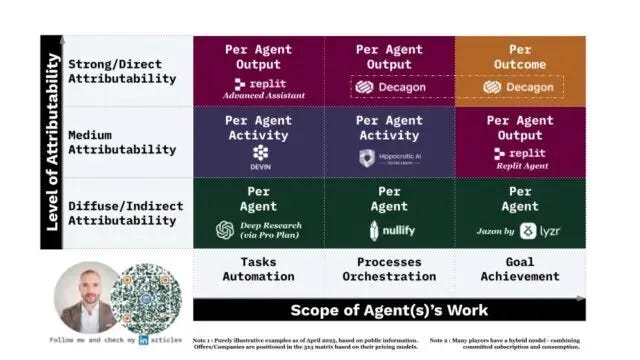
Four main pricing categories:
🎯Per Agent - like hiring a digital assistant
🎯Per Activity - when your activity is metered (API call, support ticket, etc)
🎯Per Output - charging is based on finished deliverables (for example, a report, an executed workflow, etc.)
🎯Per Outcome - charging is based on clear business results (savings created, revenue generated). This is also closely linked to value-based pricing.
The picture above illustrates two key dimensions: “Scope of Agent’s Work“ and “Level of Attribution.” Let’s view the “Scope of Agent’s Work” first. It has three distinctive categories:
SCOPE OF AGENT’S WORK
⭐Task Automation - Low-risk jobs that are repeatable and quick. The article gives an example of an agent that scans incoming invoices, extracts line items, and uploads them to an ERP system.
⭐Process Orchestration - An agent that coordinates moving parts across systems. Again, the article gives an example of an insurance claims-processing agent that coordinates multiple systems.
⭐Goal Achievement - an agent that acts as a senior strategist who chooses their own playbook to hit high-level targets. The article gives an example of a marketing strategy agent that autonomously manages ad spend across channels, choosing campaigns, reallocating budgets, and designing experiments to maximize return on ad spend (ROAS).
LEVEL OF ATTRIBUTION
The second dimension, “Level of Attribution” tells us the level of proof that we can give to the AI that performed the task. It will respond to the question “How directly can you credit your AI for the desired result”? The categories are as follows:
➡️Diffuse (weak) - there is a real impact, but it is hard to isolate, and the value might be more qualitative than quantitative. The article gives an example of a meeting assistant who schedules, records, and summarizes calls. There is a real impact, but it is hard to isolate from other factors.
➡️Medium - the outputs are clear, but the link to the business outcome might still be influenced by other factors or harder to quantify precisely in monetary terms. For example, a customer-support copilot that drafts responses for human agents.
➡️Direct (or strong) - the agent’s actions are directly measurable, and the outcomes are easily tracked, valued, and mutually accepted. The article provides an example of a dynamic e-commerce pricing agent that automatically adjusts product prices in response to demand.
When evaluating your agent, define where it should be placed on the quadrants. This brings you an idea of how to price your agent. For example, in the top right corner, there is strong attributability and strong goal achievement; therefore, the pricing should be based on the outcome. Similarly, agents in the lower left corner, with diffuse/indirect attributability and task automation, should have pricing based on a per-agent basis.
I have followed the work from Zuora for years, and they do bring lots of good industry information to the software industry without pushing their platforms and that is something I appreciate. The same applies to Ibbaka. Both organizations are doing research in monetization and pricing-related topics. Both have platforms that provide evidence of the models used by organizations, offering statistical data on market trends.
I would like to hear your thoughts on the framework and whether you can place your agent into any of those quadrants. And if you don’t know what is missing?
Yours,
Dr. Petri I. Salonen